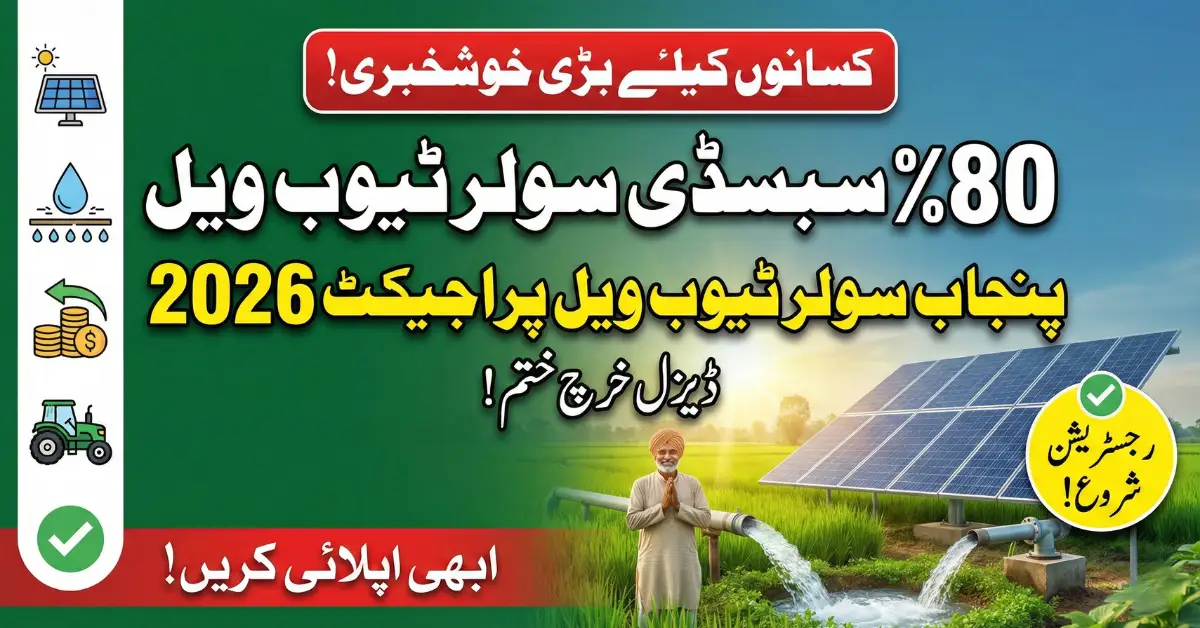
The Punjab government has launched a major relief initiative for the agricultural sector. The Punjab Solar Tubewell Project 2026 aims to reduce electricity bills, cut diesel expenses, and promote renewable energy in farming.
With rising fuel prices and frequent power shortages, farmers have been struggling to manage irrigation costs. This new subsidy program offers a practical solution — shifting from diesel and electric tubewells to solar-powered systems with up to 80% financial support.
January registrations are now open, and officials have confirmed that applications will be processed in phases to ensure transparency.
Focus Keyword: Punjab Solar Tubewell Project 2026
Tags: Punjab Government Schemes, Solar Tubewell Subsidy, Farmer Relief Program, Agriculture Support 2026
What Is the Punjab Solar Tubewell Project 2026?
The Punjab Solar Tubewell Project 2026 is a government-backed scheme designed to help farmers convert their existing irrigation systems to solar energy.
Instead of relying on expensive diesel or unstable electricity supply, farmers can install solar panels to run their tubewells. The government covers up to 80% of the total cost, while the farmer pays the remaining share.
The program is being supervised by the provincial agriculture department and implemented district-wise.
Why This Scheme Matters for Farmers
Farmers across Punjab have been facing:
-
High diesel costs
-
Increasing electricity tariffs
-
Load shedding during peak irrigation seasons
-
Reduced crop productivity
This project directly addresses these problems.

Key Objectives of the Project
-
Reduce dependency on diesel and electricity
-
Promote clean and renewable energy
-
Improve crop yields through uninterrupted water supply
-
Support small and medium landholders
-
Strengthen food security in Punjab
The shift to solar energy is not just a cost-saving step. It is a long-term investment in sustainable agriculture.
Latest Update – January 2026 Registration
According to recent government announcements, the Punjab Solar Tubewell Project 2026 has entered its implementation phase.
Registration for January 2026 is officially open. Authorities have confirmed that:
-
Applications will be verified through land records
-
Subsidies will be distributed in stages
-
Only eligible and verified farmers will be selected
Farmers are advised to apply early to avoid missing out in the first phase.
Eligibility Criteria for Farmers
Not every applicant will qualify. The government has set clear eligibility rules.

To apply for the Punjab Solar Tubewell Project 2026, a farmer must:
-
Be a resident of Punjab
-
Hold a valid CNIC
-
Own agricultural land with verified records
-
Provide land ownership documents
-
Apply for only one subsidized solar tubewell
Priority is expected to be given to small and medium-scale farmers.
Proper documentation is crucial. Incomplete applications may be rejected.

How to Apply for Punjab Solar Tubewell Project 2026
Farmers can apply through both online and offline methods.
Online Application Process
-
Visit the official Punjab Agriculture Department website.
-
Open the Solar Tubewell Project registration section.
-
Enter CNIC and land details.

-
Upload required documents (CNIC copy, land record).
-
Submit the form and wait for verification.
Offline Application Process
-
Visit the nearest Agriculture Department office.
-
Collect the application form.
-
Fill it carefully with accurate details.
-
Attach required documents.
-
Submit and receive acknowledgment slip.
Applicants should keep copies of all submitted documents for record.
Major Benefits of the Solar Tubewell Scheme
The Punjab Solar Tubewell Project 2026 offers multiple benefits beyond just subsidy.
1. Massive Cost Savings
No recurring diesel expenses. No heavy electricity bills. Over time, savings can be substantial.
2. Uninterrupted Irrigation
Solar systems work during daylight hours, ensuring crops receive timely water supply.
3. Low Maintenance
Solar systems require less maintenance compared to diesel engines.
4. Environmental Protection
Reduced carbon emissions and pollution.

5. Financial Stability for Farmers
Lower operational costs mean better profit margins.
Diesel vs Solar Tubewell – What’s the Difference?
Diesel tubewells require continuous fuel supply and regular maintenance. Fuel prices increase every year. Maintenance is expensive.
Solar tubewells, on the other hand, run on sunlight. There is no fuel cost. Maintenance is minimal. Long-term savings are significant.
While installation cost is higher initially, the 80% subsidy under the Punjab Solar Tubewell Project 2026 makes it affordable for most farmers.
Challenges Farmers Should Know
Although the scheme is beneficial, some challenges remain:
-
The remaining 20% cost may still be high for very small farmers
-
Awareness in remote villages is limited
-
Technical knowledge about maintenance is needed
-
Transparent allocation must be ensured
The government has indicated that awareness campaigns and technical guidance will be provided.
Future Expansion Plans
Officials have hinted that the project may expand further if the first phase succeeds.
Possible future steps include:
-
Extending subsidy coverage

-
Offering bank financing options
-
Introducing smart irrigation technology
-
Promoting water conservation systems
If implemented effectively, this project could transform Punjab’s agricultural landscape.
FAQs
1. What subsidy is offered under Punjab Solar Tubewell Project 2026?
Farmers can receive up to 80% subsidy on solar tubewell installation.
2. Who can apply for this scheme?
Punjab-based farmers with valid CNIC and verified land ownership can apply.
3. How can farmers register?
They can apply online through the Agriculture Department website or offline at local offices.
4. Is there a deadline for January registration?
Registration has started in January 2026. Farmers should apply early to secure their chance.
5. Can a farmer apply for more than one tubewell?
No. Only one subsidized solar tubewell per farmer is allowed.
Conclusion
The Punjab Solar Tubewell Project 2026 is a major step toward renewable agriculture and farmer empowerment. With an 80% subsidy, this initiative reduces irrigation costs, boosts productivity, and promotes clean energy.
For Punjab’s farmers, this is more than just a subsidy. It is an opportunity to secure long-term savings and sustainable farming.
If you qualify, don’t delay. Apply early and take advantage of this government-backed agricultural support program.